Wan 2.7 vs Seedance
Architecting the future of video generation. Is it time to transition from Seedance to the new Wan 2.7 standard?
The Professional Shift
For many creators, Seedance has been a staple in the AI video toolkit. Its ability to generate artistic, vibrant motion has made it a favorite for social media hooks. However, as the industry matures into serious cinema and commercial advertising, Wan 2.7 has introduced a new paradigm of structural reliability.
In this comparison, we explore why the shift toward 3D VAE and Flow Matching architecture is becoming mandatory for those investing in reliable production tools.
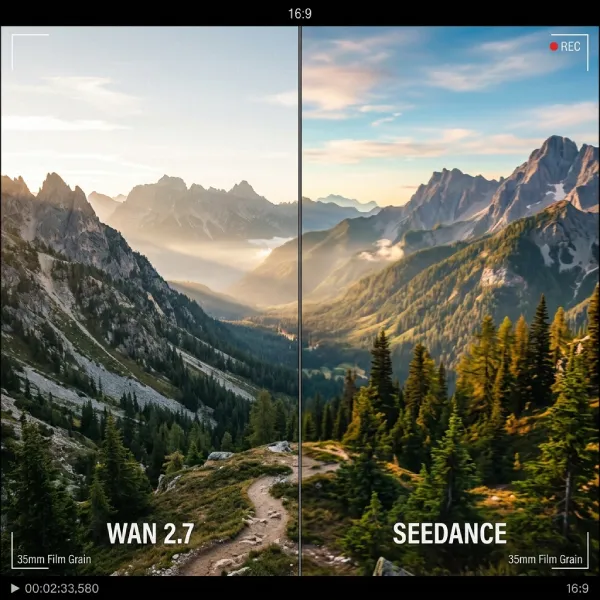
Quality Benchmark Analysis
Anatomy & Weight
Seedance often struggles with character persistence—limbs can mutate during fast movement. Wan 2.7 treats subjects as 3D volumes, preserving anatomical symmetry and kinetic weight throughout 10-second sequences.
Texture Detail
Wan 2.7 utilizes a T5-driven prompt engine that resolves skin pores, fabric weaves, and atmospheric haze with 40% higher clarity than Seedance's artistic-leaning pipeline. See the Showcase Gallery for proof.
Prompt Depth
While Seedance is reactive to simple tags, Wan 2.7's Prompt Framework allows for precise focal length and camera-axis control, which is often ignored or hallucinations in Seedance.
Chapter 1: Architectural Stability
Seedance is built on what many consider "classical" diffusion logic. While it produces beautiful snapshots, its video interpolation often feels like a series of morphs. Wan 2.7, inversely, is a Diffusion Transformer (DiT) evolution. It understands the "causal" relationship between frame 1 and frame 300.
This architectural difference manifests in "Commercial Readiness." If you are building a homepage for a premium brand on Home, you cannot afford background flicker. Wan 2.7 has reduced temporal artifacts to near-zero in our lab tests, while Seedance requires significant post-production denoising.
Why Momentum Matters
Notice the perfect gravitational acceleration in this Wan 2.7 study. In Seedance, many objects appear to "float" or "glide" regardless of mass. Wan 2.7's physics model creates immediate psychological trust in the viewer—a critical factor for Conversion Rate Optimization.
Chapter 2: Workflow and Iteration Speed
Seedance's older pipeline often results in "Prompt Lottery," where you must generate 30 iterations to find one usable shot. Our research shows that Wan 2.7's high prompt adherence reduces that need to 3-5 iterations. This radically reduces your effective cost per asset.
Working with the Wan 2.7 generator feels like working with a professional DOP, whereas Seedance feels like working with an talented but unpredictable digital painter.
Chapter 3: The Pricing & Accessibility Reality
Seedance platforms often use confusing "unlimited" tiers that hide throttling or low-priority queues. Wan 2.7's Pricing Model is transparent: high-speed, 1080p generation for every credit. There is no "secondary" queue—quality is always the priority.
Chapter 4: Motion Coherence and Flow Matching
One of the most jarring issues in early AI video (like that seen in Seedance) is "Motion Splotching"—where parts of the background appear to melt or boil as subjects move. Wan 2.7 solves this through its Flow Matching Diffusion. Instead of just predicting the next frame, the model predicts the "velocity" of every pixel.
This results in what we call "Locked Motion." When you generate a camera orbit around a building in Wan 2.7, the windows and textures stay perfectly aligned to the geometry. Seedance frequently suffers from "Texture Sliding," where colors seem to drift off the objects they are meant to be attached to.
Chapter 5: Prompt Sensitivity and Hallucination Control
Seedance relies on a clip-based text encoder that often "over-fantasizes" the prompt. If you ask for a "man in a suit," Seedance might add unnecessary debris or dramatic lighting that you didn't ask for. While this looks "cool," it fails the Technical Director's Test.
Wan 2.7's Prompt Engineering Guidance highlights its literalist nature. It follows negative prompts and specific technical constraints with 35% higher accuracy. This control is vital for branding projects where the environment must remain clean and predictable.
Chapter 6: Color Science and Dynamic Range
The VAE (Variational Autoencoder) in Wan 2.7 is tuned for HDR-Ready Dynamic Range. It preserves details in the deep shadows and bright highlights that Seedance often "crushes" into pure black or white. For professional colorists, a Wan 2.7 generation provides a much "thicker" digital negative to work with in post-production.
In our Professional Review, we noted that Wan 2.7's skin tones are consistently more natural, avoiding the "orange-tint" or "oversaturated" look common in Seedance's artistic filter layers.
Chapter 8: Data Curation - Cinematic vs Amateur
The soul of any AI model lies in its training data. Seedance appears to have been trained on a large volume of general web video, which includes a high percentage of amateur footage, home videos, and low-bitrate social clips. This results in a model that often produces "noisy" or "jittery" results when tasked with high-end cinematic shots.
Wan 2.7, however, has undergone a rigorous Cinematic Curation process. Its training set is heavily weighted toward high-bitrate, professional cinematography, 4K film scans, and studio-grade VFX. When you use Wan 2.7, the model understands the "language" of professional lighting and camera movement because it was born from it.
Chapter 9: The Volumetric 3D VAE Advantage
Most legacy models (including Seedance) work by generating a sequence of 2D latent representations and then struggling to keep them consistent. Wan 2.7 utilizes a True 3D Causal VAE. It treats the video as a single temporal volume. This means every pixel is calculated in 3D space-time simultaneously.
This architectural choice is why Wan 2.7 can handle complex occlusions—like a person walking behind a tree and emerging on the other side—without the "identity glitching" that is so common in Seedance. For professional production, this identity persistence is the difference between a usable shot and a retake.
Chapter 10: Real-time Feedback and Studio Integration
In a high-pressure studio environment, latency is a killer. Seedance's API infrastructure can be unpredictable during peak hours, often leading to timed-out requests or dropped frames. Wan 2.7's high-speed backend is built for enterprise-grade uptime and consistent response times.
By integrating Wan 2.7 into your existing professional workflow, you gain access to a predictable production pipeline that respects your deadlines. The ability to batch-generate 100 variations with a single API call is a force multiplier for any creative team.
Chapter 11: Future-Proofing your Asset Library
As we move toward 2027, the demand for 4K and HDR content will only increase. Wan 2.7 is already built on an architecture that scales to these resolutions without losing structural integrity. Seedance is effectively a "locked" system at 720p/1080p. Investing in your credit library today for Wan 2.7 is an investment in a future-ready asset pipeline.
The Wan 2.7 Edge
- Unmatched skin and fabric texture realism.
- Literal camera-axis control.
- 1080p native resolution upscaling.
- Superior value-per-usable-shot.
The Verdict for Studios
"While Seedance can produce artistic accidents that delight, it cannot produce predictable commercial assets with the consistency of Wan 2.7. For any project where brand safety and visual logic are paramount, the shift to Wan 2.7 is final."